The Dynasty That Rewrote the World

Somewhere in Frankfurt, a red shield hangs above a door. In a Bavarian study, a professor is handed a plan he did not write. Two books appear in the 1790s, one by a Scottish scientist, one buried in police files. Between them sits the most consequential family in modern history — and the part of its story the classroom never finished.
There is a film that surfaces, almost as an aside, in the twelfth chapter of a longer and stranger work called The Bible Under the Microscope. Nobody watches it as history. It carries the grain of myth — gods moving among mortals, bloodlines kept sealed, rooms where the real decisions are taken while the street outside is handed a different account — and for that reason it does something the sober documentary cannot. On the screen you are shown a mirror. In the mirror you find a hierarchy.
The film gestures at a proposition with uncomfortable consequences, and the pages that follow will try to document it. The border between what we were told and what was withheld carries weight. Whole systems of belief — about providence, about money, about who has the right to rule — lean on the quiet assumption that the received account is honest and merely unfinished. Remove that assumption and nothing collapses at once. The ground simply begins to sound different underfoot.
Neither history nor scripture reaches us neutral, because both are assembled, and assembly is a form of authorship. What gets included, what gets dated, what gets footnoted and what is left to rot in a basement: each of those choices serves somebody, and not always the reader. The most effective distortions were rarely crude forgeries. Omissions dressed as completeness do more damage than inventions, and they survive longer, because nobody thinks to check what was left out.
So the working suspicion here is narrow. Every claim is asked where it comes from. What looks solid may be a facade with real weight behind it; what nobody questions may be the visible edge of something larger. Nothing here is meant to replace one dogma with a fresher one, or the textbook with a rumour. The test is whether the picture can survive being checked.
What follows is closer to an assault on what you believe you already know — on the version of the last three centuries installed in you in a classroom, by a textbook, by an authoritative voice on the radio, long before you were old enough to ask whether any of it held together. The pieces will be laid out like a puzzle on a desk: dates, names, doctrines, documents, forming a story that in several places reveals itself as false and in several more as conveniently truncated.
Provocation is guaranteed, and so is discomfort, because the material unsettles certainties handed to you as gifts. But there is honesty inside it. Truth does not fear verification, and judgment does not harden without being tested. If something here bothers you, the remedy is investigation rather than obedience to a new creed.
One clarification before the machinery starts turning, because this topic attracts belligerence and does not need it. No faction is on trial. Everyone involved belongs to the same species, whatever the paperwork claims. What we are chasing are mechanisms: methods of control devised, tested, refined, and then applied again and again across two and a half centuries with the consistency of an engineer rather than the passion of an ideologue.
The backbone of this account is a single English book, The History of the House of Rothschild by Andrew Carrington Hitchcock, published in 2007, which traces the family from roughly 1743 and lets the arithmetic of two hundred and fifty years do most of the talking. Around it sit the primary sources a sceptic can still find and read: the founding papers of a secret order, the testimony of a Scottish scientist who watched a continent catch fire, the decrees of a parliament that did not yet understand it had already lost the argument. Where the evidence is solid, it will be presented as solid. Where a leap is required, the leap will be named. And where the story is genuinely strange, the strangeness will be left standing rather than tidied away.
This first instalment covers a compressed but decisive window, from 1743 to 1798. In fifty-five years, a family of coin dealers becomes the banker of princes, a secret society is designed in a Bavarian study, an ancient monarchy is torn down in Paris, and the power to create a nation’s money crosses an ocean and changes hands. By the end of that window the blueprint is complete. Everything after it — the wars, the central banks, the institutions with noble acronyms and unaccountable budgets — is execution rather than invention.
The account proceeds chronologically through events that can be checked, because chronology is the cheapest defence against conspiracy and the cheapest route to clarity. Where the official narrative and the documented record diverge, both will be shown and the divergence allowed to speak. That divergence is rarely accidental, and it is rarely random.
A red shield above a door
Born in 1743 — a date some registers push into the following year, which is itself a small lesson in how elastic a record becomes once a family starts to matter — Mayer Amschel Bauer opened his eyes inside the most confined address in Europe. Frankfurt am Main was a free imperial city, proud, prosperous and Lutheran in its bones, and at its centre, squeezed between a wall and the river, lay the Judengasse: a strip of houses where the city’s Jews were legally required to live, forbidden to own land beyond it, restricted in the trades they could practise, and taxed for the privilege of existing at all.
The ghetto was not a figure of speech. It was architecture deployed as policy. Gates that shut at night, a curfew enforced by chain, a fixed quota of families permitted to marry each year so that the community could be counted and capped. Growth was rationed. Inside that rationed space, a particular intelligence was being bred by necessity: the ability to read value in a glance, to move money without moving matter, to survive by anticipating what a prince would want before the prince knew it himself.
Mayer’s father, Moses Amschel Bauer, ran a counting house — part exchange bureau, part pawnshop, part informal bank — and lent money at interest. On the door hung a red sign bearing a hexagram, the six-pointed star. Street numbers barely existed then; a house was known by its sign, and for Jewish families across the German lands such marks served as address and lineage at once. A name is a coat of arms in disguise, and this one was not chosen at random. Rot is red. Schild is shield. The red shield hardened into Rothschild, and a piece of furniture was born that would outlast the thrones it leaned against.
The hexagram carried a second freight. Symbols in that world were working tools rather than ornaments, and the six-pointed star had a long, tangled biography before anyone folded it into a national flag. It travelled from medieval cabalistic diagrams through the guilds and the guild-like lodges, and it now sits on synagogues and on the dollar bill, on the Pope’s miter and on monuments whose builders rarely explain why. Mayer grew up around a father who treated these marks as instruments, and whatever else he inherited, he inherited the conviction that the sign in front of a door could decide the fate of everyone behind it.
The boy was schooled the way the quarter schooled its children: Hebrew, the Talmud, the discipline of arguing a text from every angle until nothing inside it looked accidental. A mind trained on commentary learns to read a document for what is missing as much as for what is present, and the Rothschild temperament — patient, exact, suspicious of polished surfaces — bears the fingerprints of that training. He also learned the coin trade, because coins were the one commodity a ghetto boy could handle without permission: a disc of metal whose worth could be judged by weight, fineness and rarity, and whose owner might be anyone.
Then the father died, and the arithmetic of the quarter reasserted itself. The son came back from apprenticeship to take over a business that barely deserved the name. What he had going for him was an unusual pairing: the literacy of a merchant and the patience of a man who had learned to wait inside a locked street while the rest of Europe moved freely around him. That patience would be repaid with interest.

Learning to lend to kings
The 1760s found Mayer working for the Oppenheimer banking house in Hanover, and the move mattered more than any single deal he closed there. Hanover ran at a different temperature of money, attached to a different class of client, and it gave the young man a view of finance the Judengasse could never have supplied. He became, by the standards of the place, successful — a minor partner with a growing sense of how large the game could grow. He also acquired a contact, General von Storf, whose usefulness would only become visible years later.
Those years taught him the distinction that would define the dynasty. Lending to individuals is a trade; lending to governments and royal houses is an industry. A private borrower defaults and disappears. A state defaults by rearranging its own taxes, which means the creditor is repaid out of the population’s future labour, and repaid again, and again, in a loop that never has to close. Once Mayer understood that, the counting house in Frankfurt stopped being a shop and became a lever.
A banker who lends to many clients is powerful. A banker who lends to one sovereign becomes indispensable, because he alone knows the true state of the sovereign’s finances. Mayer had no capital worth the name in those years. What he had was a memory for numbers and an ear for gossip, and in a world where the accounts of princes were state secrets, that was enough to buy a seat at the table.
Renting out his own people
General von Storf was attached to the court of William, heir to Hesse-Kassel and ruler of Hanau, and William’s fortune had a peculiar origin. Hesse had turned its population into an export: it leased soldiers to foreign powers at war, taking payment in silver and returning the survivors later, if at all. Hessian troops were the most disciplined in Europe and the most reliably for sale, and the trade made their ruler one of the richest men in the German lands, a fortune built out of other people’s wars and sitting in his vaults waiting for a use.
That was the door. Mayer approached the prince with coins and curiosities at prices a courtier would consider flattering, and in doing so made himself known to the man whose vaults held the money. The method was almost insultingly simple and entirely effective: be useful in small things until you are trusted with large ones. When he offered the prince a share in whatever else he might propose, he was not offering a favour so much as a dependence dressed as a courtesy, and William accepted it the way princes accept flattery, without noticing the hook inside.
The largest market for the mercenary trade opened in the 1770s, when Britain found itself short of men to crush its American colonies. Hesse supplied tens of thousands of soldiers — the “Hessians” whose name entered the American vocabulary as a synonym for foreign hirelings — leased to London for hard currency and paid in silver that accumulated in the Landgrave’s vaults. Follow the money and something begins to appear: the same financial world quietly funding colonial resistance on one shore was, on the other, being paid by the soldiers shipped out to suppress it. The Hessians fought for the crown, the Hesse treasury swelled, and the Rothschilds managed the prince’s silver while French money, arranged through the same lodge networks humming in Paris for a decade, drained Britain until it tired of the war. Everyone bled. The creditors grew.
The price of a title
By 1769, the arrangement had produced a title. The prince authorised Mayer to hang a sign identifying him as M. Rothschild, assigned to the court by His Highness Prince William of Hanau — court agent. The wording sounds ceremonial; the consequences were financial. A court agent could front for the treasury, could move the prince’s money, could lend the prince’s credit to others and keep a margin. The man who had once identified himself by a red shield now identified himself by proximity to a throne, and the throne did not yet realise that the proximity ran in both directions.
What changed that year was structural rather than financial. A merchant’s word is worth what his stock is worth. A court agent’s word is worth what the prince’s vaults are worth, and the prince’s vaults were worth a great deal. Overnight, Mayer could borrow against a credit that was not his own, relend at a margin, and keep the difference. A man with almost no capital had acquired the use of a fortune, and the fortune’s owner was flattered to have been asked.
Marrying inward
Before the machinery accelerates, one family habit deserves attention, because it looks archaic and turns out to be strategic. The Rothschilds married inside their own clan with a consistency that startles a modern reader. Cousins wed cousins; a man’s daughter became his nephew’s wife; the circle was drawn and then drawn again. To a contemporary eye this resembles the biblical patriarchs, where Abraham, Isaac and Jacob all took spouses from within the kin, and the resemblance is not accidental, because the logic is identical. Marriage inside the line keeps property inside the line, and property kept inside the line becomes an estate no outsider can dilute, inherit away, or vote against.
Endogamy has costs. It concentrates both wealth and whatever weaknesses run in the blood. For a family whose whole project was to convert private money into public power, dilution was the greater danger, and the Rothschilds chose accordingly. The clan would grow in number and in reach, but the boundary would not move. A new son-in-law from outside could bring in capital and opinions; the Rothschilds preferred neither, and their marriages were arranged to admit as little of either as possible.
Five arrows, five capitals
A dynasty confined to one city is a rich man with relatives. A dynasty spread across the capitals of Europe is infrastructure, and infrastructure is what converts money into power. Mayer grasped this earlier and more coldly than anyone around him, and his instrument was the oldest available: his own children.
He and Gutle had five sons who reached adulthood, and the sons were not kept together. They were deployed. Amschel, born 1773, stayed in Frankfurt to hold the home office and the ledger. Salomon, born the following year, was aimed at Vienna. Nathan, born 1777 and the most formidable of them, was sent toward England — Manchester first, then London, where he would eventually sit astride the money market of Europe. Carl, born 1788, was directed at Naples. James, born 1792 and the youngest, would take Paris. Five sons, five cities, one name.
The crest says the arrangement out loud. A hand grips five arrows, and beneath it the motto reads Concordia, Integritas, Industria — concord, integrity, industry. Five shafts in a single fist: take one and it snaps, take five and the fist answers. It is heraldry that doubles as an organisational chart, and there is no reason to think the imagery was casual.
Every son entered the family business at twelve. Every son married inside the clan. The boundary therefore never moved outward, which meant the firm never had to admit an outsider into its accounts, never had to publish a balance a rival could read, and never had to answer to anyone but itself. A bill drawn in London, honoured in Frankfurt, discounted in Paris and settled in Naples travelled through family hands alone, leaving a trail too thin for a tax collector and too narrow for a competitor to squeeze into. By the early nineteenth century the same hand could finance a war in one capital, hedge it in a second, and be paid by the defeated as well as the victorious. Five houses, five countries, one grip.
A project handed to a professor
The year 1770 is where the story turns from banking to architecture, because that is when Mayer Rothschild is said to have drafted the scheme for an order that would later call itself the Illuminati, and to have handed its development to a man who could give it intellectual cover: Adam Weishaupt.
Weishaupt was a professor of canon law at Ingolstadt, born into an Ashkenazi background but raised and ordained within the Roman Catholic world, a man straddling two inheritances and belonging comfortably to neither. The order he built took its name from a word meaning “the enlightened,” a wink at the fashion of the age and a claim on its most valuable commodity: reason itself. Anyone who opposed the order could then be cast as opposing the light.
On 1 May 1776, Weishaupt finished organising the structure, and the date was not lost on later observers: the first of May would eventually become a global holiday, and its roots run into that Bavarian founding rather than into any factory floor. What the order wrote down as its purpose repays slow reading, because it is stated plainly and then executed with remarkable fidelity for the next two centuries.
What Weishaupt built was not a debating society. It was a graded machine, and the grading carried the power. New members entered at the bottom, as Minervals, and climbed a ladder of degrees toward higher and more secret rungs, with the innermost circles known only to those inside them. A member at the bottom could not know what the members above him knew, so no single leak could expose the whole. Compartmentalisation, centuries before the word, as a security doctrine.
Secrecy was enforced with real discipline. Members adopted classical aliases — Weishaupt was Spartacus, his lieutenant Zwack was Cato — so that intercepted correspondence read as antique history. Candidates were watched before admission, their habits and weaknesses catalogued, and the order’s internal reports read like the dossiers of a modern intelligence service. There were monthly returns, rules of conduct, penalties, and a ladder of loyalty that rewarded silence. Much of what later generations would reinvent and call tradecraft began in that Bavarian study and has since become the ordinary texture of professional life. We live inside the order’s habits and call them normal.

Divide, finance both sides, rule
What the order committed to paper was a method rather than a philosophy, and the method had a target: the goyim — everyone outside the fold, and, pointedly, also the Jews the order did not count as belonging to itself. That distinction explains a tone of studied distance from every existing institution. The Illuminati did not set out to reform the church or the state. It set out to dissolve both into something else, using the seams already present in them.
The stated aims reduce to three motions, and they are worth listing plainly, because everything that follows — every war, every panic, every manufactured crisis of the next two centuries — is a variation on them:
- Divide the population through political, economic, social and religious means, manufacturing conflicts, wars, strikes, upheavals and ethnic riots where none needed to exist.
- Finance both sides of every conflict, so that whoever wins, the creditor wins, and the losses are paid by the combatants in blood and by the survivors in interest.
- Dismantle the nation-state and the church as independent centres of loyalty, replacing them with structures answerable to no single people.
Read that list against the history you were taught and it becomes difficult to unsee. Two world wars fought by the same financiers on both sides. Revolutions that arrive on schedule, in several countries at once, with identical slogans. Institutions created “to end war” that never end war but acquire the power to overrule the states that created them. The list was written down before the events it predicts, which is the strongest thing that can be said for it and the hardest to dismiss.
Bought with money, held with appetite
To execute the plan, the order needed instruments, and Weishaupt specified them with the precision of a man who distrusted enthusiasm. Recruits were to be bought two ways: with money, and with access to sex, because a compromised man is cheaper than a convinced one. Once a target was entangled, he was held by blackmail and by the credible threat of ruin — financial collapse, public exposure, and, where required, death. The order did not rely on a man’s principles. It relied on his appetites and his debts, which are more reliable.
Talent was harvested young. Agents scouted the ablest students in colleges and universities and trained them in a specific doctrine: that lasting peace requires a single world government. The argument is elegant and false by design. If you believe that only one authority can end war, you will accept the gradual transfer of sovereignty to that authority, never noticing that the same people were arranging the wars that made the transfer seem necessary. To recruit this cadre, the order funded scholarships, and the funding explains a detail of academic life nobody questions today: why so many great universities run on endowments of vague origin, and why so many of their most promising graduates end up “advising” governments from positions that were never on any ballot.
These trained men were then planted inside every administration, dressed as experts and specialists behind the scenes — close enough to shape policy and far enough from it to escape blame when policy fails. From that arrangement comes the modern illusion that the people we elect are the people who govern. They occupy the visible chairs, owe favours in the form of loans, contracts and careers, and serve as the face of decisions taken elsewhere. The alphabet of international institutions, with its noble acronyms and unaccountable budgets, was not an accident of the twentieth century. It was the original ambition, in seed.
Then came the press, the only mass medium of the age, and here the order was ruthless about something we still struggle to admit: whoever controls the supply of news controls the shape of reality for everyone who reads it. News could be selected, framed, delayed, inflated or killed, and the public, having no independent channel, would take the curated version for the world itself. What we call the mainstream media is not a modern invention; it is a structure whose blueprints were drawn in a Bavarian study and which has only grown more refined since, refined to the point that after 2020 the word “censorship” returned to ordinary conversation and the supposedly free internet began to behave like a broadcast tower with a man at the switch.
None of this is speculation about intent. It is what the order’s own founding documents say, and the documents survive.
Borrowing the apron
Freemasonry gave the plan what a Bavarian study could not: a network that already existed, already tolerated, already respectable, and already international. Weishaupt is said to have infiltrated the secret Masonic order and installed the Grand Orient as the order’s hidden headquarters, and the emblem attached to it — Liberty, Equality, Fraternity — would later become the official motto of the French Republic and the slogan of its national holiday on 14 July. That is not a coincidence of vocabulary. It is a signature.
Under instruction, Weishaupt recruited roughly two thousand followers, drawn from the ablest men of the arts, literature, education, science, finance and industry, and drilled them in population control. Two thousand people is a small number, which is the point. You do not need to control a nation’s millions if you can place a hundred men in the right hundred rooms.
Whether the Grand Orient was merely a useful vehicle or genuinely the order’s inner chamber remains debated, and honesty requires saying so. What is beyond dispute is that from the 1770s the leading edge of European revolution was populated almost entirely by men who moved in these circles, and that they described themselves in exactly the terms the order had taught them to use. When a vocabulary becomes that dominant that quickly, the vocabulary has a source.
The night the police found the papers
The suppression deserves more than a paragraph, because it is the hinge on which the order’s survival turned. In 1784 the Bavarian authorities, alarmed by the order’s reach, moved against it; the next year they declared it illegal and ordered the Grand Orient lodges shut. The immediate result looked like victory for the state: the order dissolved, its founders scattered, its meetings banned. The deeper result looked like victory for the order, because a doctrine that goes underground is harder to police than a doctrine that holds public meetings.
In October 1786 the police searched Xavier Zwack’s house in Landshut and carried off the archive. What they found was almost embarrassing in its completeness: encrypted letters between Spartacus and Cato, regulations, ritual scripts, recruitment dossiers, notes on bribery and assassination, and a plan to infiltrate the schools and churches. The government printed a selection under the title Einige Originalschriften des Illuminatenordens and sent it to every crown and mitre in Europe, hoping to inoculate the continent. The inoculation failed, and it failed for a reason worth stating plainly: a warning that arrives before the symptoms look like an opinion, and opinions can be filed.
The subtitle is the part that matters. These were not interpretations or studies by a later historian. They were the originals, written by the founders themselves, which is why they cannot be dismissed as a conspiracy theory retrofitted onto old events. When the Bavarian state moved against the order, it did so holding the order’s own correspondence, and when it published the papers, it published the founders’ handwriting.
Weishaupt himself, stripped of his order, retreated into relative obscurity, and this too is instructive. The order did not need its founder. By 1785 the doctrine had already been absorbed by the lodges, and the lodges did not need a headquarters. Ideas that live in a hundred cities survive the loss of the room they were born in.
A scientist against a fashion
Robison is the figure this account leans on hardest, and he is worth meeting properly. Born in Scotland and trained at Glasgow, he was professor of natural philosophy at Edinburgh and secretary of the Royal Society of Edinburgh — not a pamphleteer but a working scientist of the first rank, a collaborator of James Watt, and a man whose judgment about machinery was widely trusted. He turned to the Illuminati not out of temperamental suspicion but out of shock at the French Revolution’s violence against the church and the crown, and he recognised, in that violence, the logic of papers he had already read.
His 1798 book, Proofs of a Conspiracy against all the Religions and Governments of Europe, carried on in the Secret Meetings of Free-Masons, Illuminati, and Reading Societies, laid out the mechanism: the lodges as cover, the reading societies as a distribution network for revolutionary ideas, the wealthy as financiers, and the young and ambitious as recruits. Robison’s central argument was that the revolution had been prepared for years in the dark, and that its slogans had been tested in lodge rooms before they were shouted in the street. Stripped of his period’s flourishes, his claims were these:
- The most active leaders of the French Revolution belonged to an association of the “enlightened,” and they ran their first manoeuvres according to its principles and with its help.
- The conspirators had concluded that to succeed they must first destroy morality and religion, because a people held by the church is harder to move.
- The ground was prepared through cosmopolitan and sceptical ideas cultivated inside the Philalethes lodges, which fused with France’s economic misery; French interference in Britain’s colonial conflict pushed the court toward preaching doctrines of liberty, and returning officers and soldiers brought home a taste for independence, liberty and equality.
- Lawyers fed revolutionary morality into their pleadings, and revolutionary clubs formed and worked in secret before the National Assembly ever convened.
His conclusion was blunt and, at the time, widely mocked. The French Revolution, he argued, was not a spontaneous rising of the hungry. It was the implementation of a plan whose goal was the abolition of monarchy and all privileged orders, the eradication of religion and morality, and the institution of a universal liberty and equality that would flatten every existing authority into one. The book sold, and then it was quietly forgotten, because the official history that replaced it was simpler, flatter, and easier to teach.
What lifts Robison from idiosyncrasy to corroboration is that he was not alone. In the same years, the French priest Augustin Barruel published his own multi-volume Memoirs Illustrating the History of Jacobinism, reaching a strikingly similar conclusion by a different route. Two men, one a Scottish scientist and the other a French cleric, working independently and in different languages, arriving at the same diagnosis in the same window of time, is the closest thing to corroboration a conspiracy claim can hope for.
Robison was, for a while, celebrated, then quietly demoted. The following century preferred a gentler story in which the revolution was a natural upwelling of the oppressed, and the word “conspiracy” acquired a faintly embarrassing smell. The evidence never changed; only the taste did. That pattern recurs every time the documented record becomes inconvenient.
A revolution with a guest list
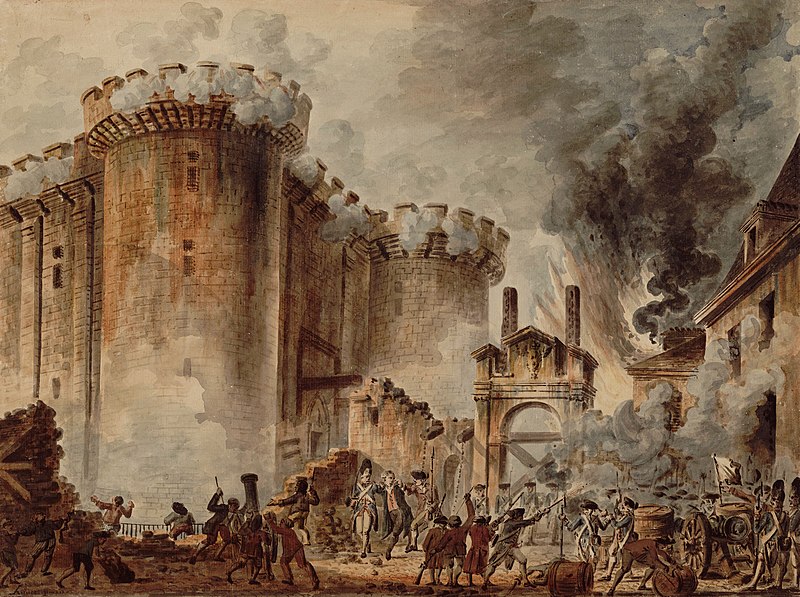
The official version is familiar enough to recite in a schoolroom, and it is not false so much as hollowed out. We are told that the French Revolution was a defining rupture in modern history, that an oppressed population rose against an absolutist king, inequality and hunger, and that the rising produced the fall of the monarchy, a republic, and the principles of democracy. We are told it bequeathed liberty, equality and human rights to humanity, swept away feudal privilege, and inspired the world. All of that is true in the way a stage set is true: the scenery is real, and the stagehands are hidden.
The documented record says something more uncomfortable. The men who organised the revolution were, with remarkable concentration, men of the lodges and the order. That is not a claim about every baker who marched; it is a claim about who wrote the script, who paid for the printing, and who chaired the committees before the committees had names.
The cast is worth naming, if only because the density is the argument.
- Louis Philippe II, Duke of Orléans — later “Philippe Égalité” — served as Grand Master of France and presided over 266 lodges of the Grand Orient in 1785. An Illuminatus influenced by Mirabeau, he used his Masonic authority as a political engine, and he had every personal reason to see the king diminished.
- Honoré Gabriel Riqueti, Comte de Mirabeau — an Illuminatus, influenced in turn by Mauvillon — reformed, with the Abbé de Périgord (later Bishop of Autun, better known as Talleyrand), a lodge of Philalethes in Paris that sat at the Jacobin convent and would become the Jacobin Club. The Jacobin Club did not invent itself; it had a founding room and a founding membership.
- Marquis de Condorcet outlined his posthumous Le Progrès de l’Esprit Humain inside the Strasbourg lodge of Philalethes — the doctrine of inevitable human progress, drafted in a lodge and then sold to a continent.
- Abbé Sieyès, author of the pamphlet that gave the Third Estate its voice, belonged to the Philalethes lodge in Paris and Lyon.
- Anacharsis Cloots, described by contemporaries as a keen Illuminatus, became a revolutionary missionary and a Representative of the Nation.
- Around them clustered Robinet, author of La Nature, ou l’Homme moral et physique; Bailly, Fauchet, Maury and Mounier; and further down the roster Pétion, La Fayette, d’Aiguillon, the Marquis de la Salle and Desprésmenil.
In 1788, a deputation was dispatched from the German Illuminati to Paris to seize the opening, its members travelling under cover names — Amelius, that is Johann Joachim Christoph Bode, privy councillor; and Bayard, that is the Lieutenant Colonel von Bussche. Two Germans arriving in a foreign capital to help midwife a revolution they had drafted years earlier is the kind of fact that ought to appear in every textbook and appears in almost none.
Slogans tested in lodge rooms
The ideological furniture of the revolution, meanwhile, was largely written before the revolution arrived. The lodges circulated a whole shelf of it: the Archives mystico-hermétiques, and Des Erreurs et de la Vérité, treated inside French Masonry as a kind of scripture; Robinet’s La Nature; Condorcet’s Le Progrès; the Declaration of the Rights of Man, which contemporaries regarded as an abstract distillation of Masonic humanism and which proved, in practice, more unstable than its authors hoped; and Lequinio’s Les Préjugés Vaincus, described by a contemporary as the most detestable book a printing press had ever produced, and precisely the vehicle that carried the order’s principles into the open.
The lodges did not only write. They issued orders. A manifesto sent from the Grand National Lodge of Paris, signed by the Duke of Orléans, called on lodges across Europe to unite behind the revolution, a continental chain of command dressed in ritual. The Convention then translated the lodge’s ambitions into law:
- The decree of 19 November 1792, in which the Convention offers aid and fraternity to every people wishing to recover its freedom — a standing invitation to revolution, issued to all nations.
- The decree of 15 December 1793, drafted on a report from the diplomatic committee, abolishing every privilege and declaring war on palaces, with the aim of toppling all tyranny and installing a popular system everywhere.
- The speeches in the Convention declaring the war’s purpose in a slogan never since improved on: the annihilation of all privileges, war with the palaces, peace with the hovels.
Read those decrees against the order’s stated goals of 1776 and the fit is exact. Divide the nations, finance both sides, dissolve the old authorities. The French Revolution was not the first domino; it was the first deliberate push.
Here the record turns almost comic in its cruelty. In 1785, the Bavarian government declared the order outlawed and ordered the Grand Orient lodges closed. That same year, Mayer Rothschild moved his house in Frankfurt to another, which he happened to share with the Schiff family — two banking clans under one roof is a meeting, not a coincidence. In 1786, the Bavarian authorities published the seized originals and sent them to every head of state and church in Europe. The response was, on the whole, a shrug. The crowned heads of Europe were handed, in printed form, the blueprint of their own destruction, and they filed it.
Why the shrug? Because a warning is only useful if it arrives at the right moment, and the order’s papers arrived while the courts were still comfortable and the French treasury was merely strained rather than collapsing. In 1784, the order is said to have decided that the coming French Revolution should appear in the form of a book signed by Maximilien Robespierre — though the manuscript, written by Zwack, was intercepted by the Bavarian police before it could be delivered. Note what the interception implies: the revolution had a script, the script had an author, and the author had a pseudonym waiting on the other end.
Why the pyramid on a stamp
A small object makes the point better than an argument. In the bicentennial year of the revolution, the French state issued a commemorative stamp, and it chose, among thousands of available images, to decorate it with the pyramid and the all-seeing eye. Around that eye cluster other marks: a staff, an ouroboros — the snake swallowing its own tail, long associated with Masonry — a Masonic hat, and female figures drawn from the lodge’s symbolic pantheon. The Declaration of the Rights of Man sits at the centre, framed by symbols the declaration’s own authors would have recognised as their badge.
Why would a modern republic, two hundred years on, reach for the order’s iconography to celebrate its own founding? The available answers are that it was decorative, or that it was deliberate. Decorations have a way of being deliberate when they recur this often. Walk any European city and the symbols are on the buildings, on the monuments, on the pediments and the tombstones, in plain view and almost never explained. The revolution established a project aimed at the thrones of Europe, and the project did not end when the thrones fell. It acquired a permanent aesthetic.
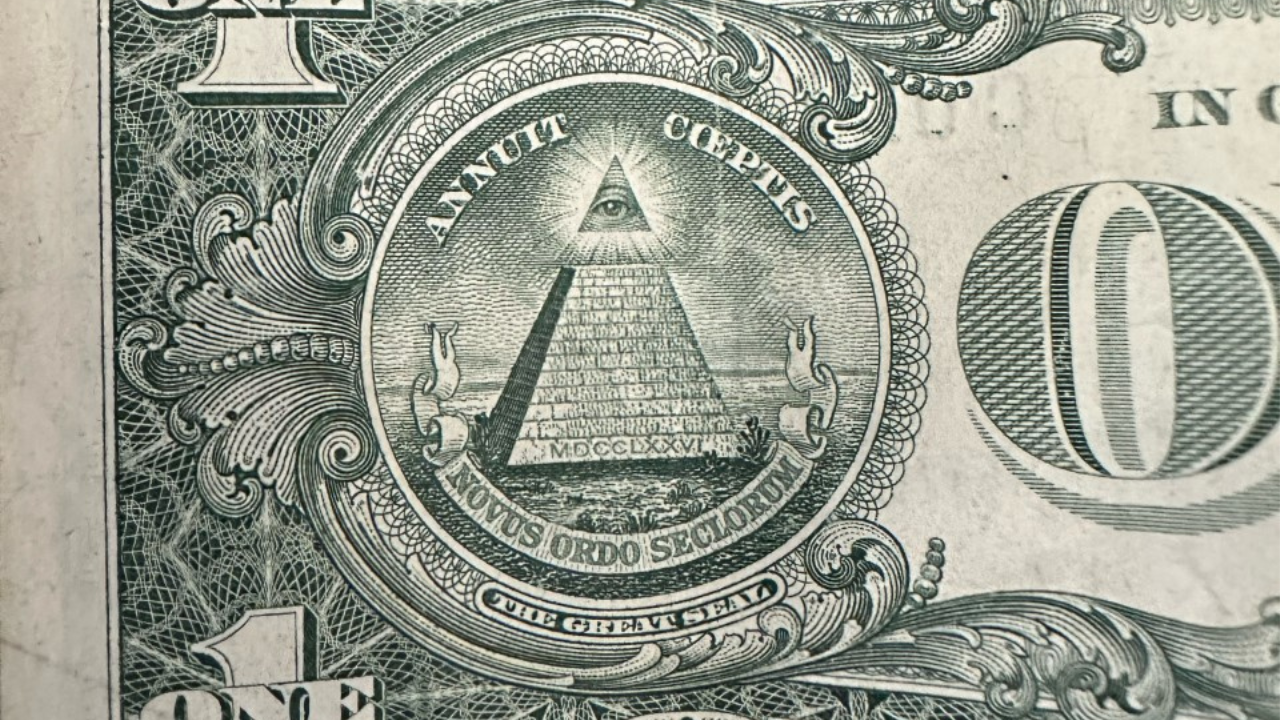
The same reading applies to the most familiar banknote on earth. The reverse of the Great Seal of the United States, designed in the revolutionary decade and adopted in 1782, carries an unfinished pyramid of thirteen courses beneath an eye within a triangle, with the mottoes Annuit Coeptis and Novus Ordo Seclorum — the latter usually translated “a new order of the ages,” and routinely, and tellingly, mangled into “a new world order.” A pyramid with a detached capstone is a structure waiting to be completed; an eye floating above it is a watcher. The men who chose those images had been reading lodge symbolism all their lives, and the banknote has carried their seal into every wallet in the world for two centuries.
The ouroboros is the darker of these marks. The snake devouring its own tail is the oldest image of a cycle that never ends and never begins, of a system that consumes itself and is reborn identical. Set beside the pyramid and the eye, it makes a small, grim sentence: an unfinished structure, watched from above, turning forever.
Let me control the money of a nation
In 1790, Mayer Rothschild is said to have pronounced the sentence that governs the rest of this series: Let me issue and control the money of a nation, and I will not care who makes its laws. Until that moment, the family’s role had been to finance states, not to create their currency. Money still belonged to governments, which minted coins and stamped their own faces on them. The quote describes a promotion, from lender to issuer. Lend to a state and it can default; create its money and the state is yours.
A year later, in 1791, the machinery reached the New World. Through their agent Alexander Hamilton, the Rothschilds acquired effective control over the issuance of American money. The Senate, on Hamilton’s design, granted a twenty-year charter creating the First Bank of the United States — the country’s first central bank, modelled on the Bank of England, and modelled, critics noted, on a bank the crown had once used to manage its debts. From that point the family no longer needed to care who wrote the laws anywhere, because the laws could always be refinanced. Every subsequent American banking crisis, every fight over whether the United States should have a central bank at all, every panic that ended with a new institution holding the money supply, descends from that charter and the fight to renew it.
Hamilton’s reasoning was respectable and, in a sense, correct. A new nation with weak finances needed a stable currency and a lender of last resort, and a national bank could provide both. His opponents — Jefferson, Madison, and the agrarian interest — argued that the constitution did not authorise it, and that a private bank with public powers was a standing threat to the republic’s sovereignty. The fight went to the constitutionality of a bank, but underneath it sat a larger issue neither side quite named: who should create the nation’s money, the people’s government or a private institution answerable to shareholders?
That issue has never been settled. It has been re-fought in every generation, and the answer has drifted steadily toward the shareholders. The charter expired and was renewed in the following decades; the fights repeated; a third attempt produced the Federal Reserve in 1913; and by the twentieth century the power to create the money of the most powerful nation on earth sat in a hybrid institution that was neither fully public nor fully private, precisely as its critics had warned.
A charter is a licence to create money
The mechanism is worth spelling out, because it explains how the quarrel worked in practice rather than in theory. A charter is a licence to create money. A bank with a charter can issue notes beyond the metal in its vaults, and every note issued is a small loan to the whole economy, repaid with interest. Whoever holds the charter therefore collects a toll on the entire productive life of the country, invisibly, forever, and never has to pass a budget or face an election to do it.
That is what made the charter fights so bitter and so frequent, and what made the losing side look unreasonable to its contemporaries. The agrarians were not opposing stability; they were opposing a transfer of sovereignty they could feel but not quite name. Each time they lost, the country gained a smoother currency and lost a measure of self-command, and the trade looked like progress from every comfortable vantage point. Whether it was progress is a question the reader can keep open. The mechanism, at least, is now on the table, and the reader can decide what to make of a system that makes debt the ordinary condition of government and calls the arrangement sound.
What the archive kept
A window like this one tempts you to declare the story finished and the verdict reached. It is better to leave the verdict slightly open, because the point of this series is not to install a new certainty but to make the old certainties answer for themselves.
What can be said without hedging is that between 1743 and 1798 a sequence of events occurred whose design is documented in the participants’ own papers, whose personnel overlap to a degree that strains coincidence, and whose results match the stated aims of a plan written down in 1776 with unusual precision. A ghetto boy inherits the confidence of a mercenary prince and turns it into a banking house. A professor with two inheritances builds an order and hands it a doctrine. A continent receives a revolution with a guest list, a set of slogans it still chants, and a set of symbols it still stamps on its money. A young republic receives a central bank and, with it, a permanent creditor. And in 1798 a respected scientist writes the whole thing down and is gently forgotten.
The dates were available, as were the documents and the symbols. What matters is how they were presented, which details received attention and which were left aside. A historical account can shape our understanding without inventing anything; the choice of what to include is often enough. The version of the past we were handed is not a forgery so much as a selection, and selection, as the order knew before anyone else, is the most efficient form of editing.
The next instalments move forward into the nineteenth century, where the blueprint becomes a building: the wars financed on both sides, the central banks installed in capital after capital, the treaties that rearranged the map, and the institutions given names grand enough to make their origins easy to overlook. If this first part was the drawing, the rest is the construction, and the construction, unlike the drawing, is still standing, which is why the reader can walk out into any city on earth and read it.
Look again at the red shield on the cover. It is a name, a heraldry, and a claim, and it has hung over the door of the modern world for two and a half centuries while the world walked past and mistook it for decoration. The only thing left to decide is whether the world was fooled, or whether it simply never looked up.


Comments
Post a Comment