The massive lies that create our reality

Who else remembers learning about recycling in grade school during the ‘80s? My class made posters, created campaigns, and all learned the “3 R’s”. It all made sense to my 9 year old brain and for about 3 decades I was a believer.

This won’t come as a shock to most of my readers, but it was all a lie. I watched industry transform every form of packaging into plastic, only to later discover my naivete.
Recycling was corporate propaganda to gain public support for cheaper plastic packaging, propel a burgeoning petrochemicals industry, and offload accountability.
MUST WATCH BELOW!!!
Food Confiscation: How to protect your food stores and production from government confiscation
Take Advantage of Our 40 Years Experience Living Off The Grid and Turn Your Home Into a Self-Sufficient Homestead
(Step by Step)The Only Video You Need to Become Self-Sufficient on ¼ Acre

For decades, we’ve been force-fed a narrative of individual responsibility designed to protect corporate profits. Coca-Cola and PepsiCo founded “Keep America Beautiful”, best known for its crying Indian (who is actually an Italian actor) PSA.

The Reduce, Reuse, Recycle mantra is a corporate shield to hide the fact that plastic recycling is technically unfeasible. Every time plastic is melted and reshaped, its polymer chains weaken. A high-quality PET bottle becomes fiber or fleece to make unrecyclable carpets and garments, which eventually hit the landfill. Globally, only 9% of all plastic ever produced has been recycled.
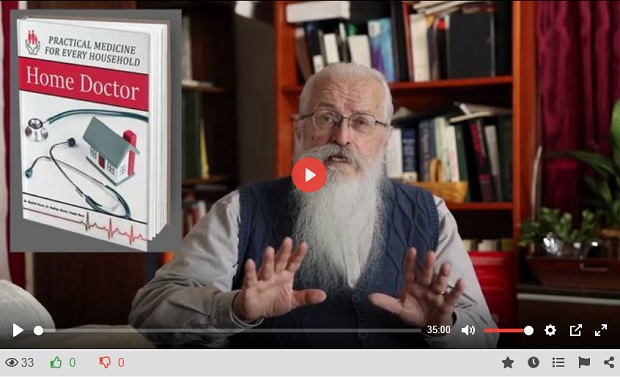
I highly recommend this book: The Home Doctor – Practical Medicine for Every Household – is a 304 page doctor written and approved guide on how to manage most health situations when help is not on the way.
If you want to see what happens when things go south, all you have to do is look at Venezuela: no electricity, no running water, no law, no antibiotics, no painkillers, no anesthetics, no insulin or other important things.
But if you want to find out how you can still manage in a situation like this, you must also look to Venezuela and learn the ingenious ways they developed to cope.
While distracted by personal responsibility, we feed the system by buying into its lies about its own actions. We consume more of its shit because, according to them, it smells better now.
Efficiency, renewables, carbon capture, recycling—each propaganda perpetrated on a public desperate to maintain the status quo by a kleptocracy willing to eat itself in the name of money.
I still recycle, disgusted by the waste but hopeful it still makes a small difference. Call me delusional, but filling the recycling box still provides an opportunity for an item to be recycled.
Alas, this article isn’t about plastic. It’s about the lies we’ve been told. Millions and millions of dollars have been spent over decades to deceive us into believing corporations have our best interests at heart.
The lie goes beyond plastics. Energy efficiency, renewables, carbon capture, fabric bags, water bottles are all victims of corporate spin.
Energy Efficiency and Jevons Paradox
The idea that efficiency leads to an improved outcome for the environment is a pervasive lie. This is demonstrated by an economic concept called Jevons Paradox. This concept argues efficiency improvements lead to an increase in total consumption. Technology lowers the cost-per-unit of a resource, which triggers its adoption across new industries and causes aggregate demand to explode.
As automobiles have become more energy efficient, total miles driven has exploded (yes, partly a function of population and number of vehicles, but IMO that supports the point - when things are cheaper people do all the things that make total usage rise, including having more kids, immigrating, buying a second car):

LED lighting is another perfect modern example. LEDs use less electricity and last way longer than incandescent bulbs. But their low cost prompted a massive expansion in total illumination. Perhaps not as destructive the automobile, but demonstrates the concept nonetheless.
Hopium Galore: Renewables and Carbon Capture
Out of all the lies told, I think renewables and carbon capture were the most destructive. These were technological promises with a great narrative that encouraged humanity to merrily pass the point of no return. These promises gave us permission to buy and build, thinking we had an escape route. The future was clean and green. People wanted to believe so badly they put their money into it: the wealth management industry is littered with the corpses of “sustainable” investment funds.
However, some (including many of my readers) saw through it from the beginning. The unfortunate truth is that most clean tech solutions ignore the staggering material throughput and the fossil fuels required to build it. Modern green infrastructure is forged in coal-fired furnaces. Core components require temperatures that electricity cannot achieve at scale:
A 3-megawatt wind turbine requires 900 tons of steel and 2,500 tons of concrete. Steel production requires metallurgical coal to reach 1100C, and cement kilns demand 1400C. (Source: National Renewable Energy Laboratory (NREL) & Vaclav Smil)
Purifying solar-grade silicon requires temperatures exceeding 2000C. Melting sand for glass requires 1700C. These heat levels are reached exclusively via natural gas. (Source: International Energy Agency (IEA))
Remote wind and solar farms rely on diesel-powered heavy-duty ships and trucks for installation.
Also, wind and solar are variable and, if battery (requiring ever-more raw materials) capacity doesn’t scale, could require keeping fossil fuel plants cycling idly in the background, racking up costs and emissions while selling no power. Furthermore, wind and solar assets die every 20–25 years, requiring repair and replacement, and immense amounts of garbage.
While renewables tell the story of perpetual clean growth, Carbon Capture and Storage (CCS) is an audacious scheme for the fossil fuel industry to stay relevant while changing nothing. Despite billions in subsidies, CCS projects are failing to deliver on their claims. The central lie of CCS is that it can efficiently suck CO2 out of the atmosphere and shove it in the ground. But did you know that the captured gas is often injected into old wells to squeeze out more oil? Essentially CCS is a net negative for the climate and a lifeline for producers.
We’ve been gaslighted into supporting a massive system that is now unstoppable. Yet, we’re still sold on using reusable bags and metal water bottles. As you guessed, these are also a victim of reality not meeting expectations. Most people have too many bags and bottles to offset the damage inflicted during their birth, life, and death.
The Renewables Farce

These are just the extinction-level lies that will end up killing us all. We’re also being misled by marketers, employers, private equity managers, politicians, pdfs...am I missing anyone? Unfortunately, sometimes our friends and family lie to us too. After all, they want to believe.
The cynic’s job never ends.
I get it, corporations exist to make money for shareholders. They are a mathematical equation, and negative externalities are only included in the equation if profitable.
The real disappointment is how our elected leaders, instead of representing the families that voted for them (naive, I know), conspired with big business to hoard wealth. While we thought our individual actions were helping the planet, something like 10 people decided on humanity’s behalf that money is more important than life, lying to us since birth.
For decades propaganda was reality, and still is for many. Like discovering your spouse has been cheating for years, learning the truth makes you second guess your own history. Every choice tainted by misinformation. Who are you really if a product of deceit?
Perhaps someday the truth will be so transparent it becomes no longer possible to deceive. We’ll be struggling for our last breaths by then.
Sadly, the lies succeeded and our future is baked in. So much wasted time and energy, and today the window for salvation is shut. In the long run, propaganda can’t outrun physics.
RENEWABLES ARE NOT A PANACEA FOR CLIMATE CHANGE
Sure, wind, solar or geothermal energy might reduce carbon intensity per unit of output. Indeed, an EV, for example, emits less carbon than an ICE vehicle.
Unfortunately, it's more complicated. It always is.
Let me stop right here for a second. I am no fossil fuels apologist. And I'm not trying to thwart the efforts to improve the planet. However, I am a realist and observer of human and political behavior. In this article, I describe what will likely happen, as opposed to what I wish would happen.
First, renewables must be evaluated from a birth-to-death perspective. This includes the manufacturing processes, inputs and raw materials extraction. Accounting for these, the tradeoff is less black-and-white and often highly influenced by the longevity of the renewable alternative.
Break-even estimates vary wildly, and are highly dependent on what you're measuring - e.g. financial cost or carbon emissions. I think it's fair to say any renewable used to replace fossil fuels must have a lifespan across decades to be a viable alternative.
Studies show conflicting information - potentially influenced by inherent biases - with one recent study suggesting the breakeven between EVs and ICE vehicles is beyond normal usage.

Other studies show carbon parity can occur much earlier, depending on the underlying energy source.
My point is there are hidden complexities beneath the renewables transition, which has been misused as a soundbite to appease the citizenry.
Looking longer-term, those hidden complexities worsen. Transitioning to alternative energy sources requires massive consumption of copper, nickel, lithium and other metals. Research by Simon Michaux, Associate Professor at Geological Survey of Finland, suggests at current production rates there simply won't be enough raw materials to feed the transition.
Some argue his analysis doesn't anticipate technological developments, such as improvements in storage capacity and sodium batteries, that reduce metals requirements. (Note: the potential for cheaper, more effective future technological advances has long been an excuse for doing nothing to mitigate our predicament.) Still, Michaux highlights a major challenge to the feasibility and expediency of the transition, given what we can do today.


Since the beginning of time, all gases (even the most toxic) emitted by terrestrial volcanoes and marine and oceanic hot springs (called 'mini-volcanoes') that line the bottom of basins diffuse into our atmosphere where they are immediately recycled (otherwise life on Earth would never have appeared). Similarly, carbon dioxide (the heaviest gas of all) is recycled in the water of seas and oceans (78% of the Earth's surface) as well as in rivers, lakes, rain, fog, and puddles thanks to phytoplankton present on their surface, which breaks down into carbon nanoparticles (charcoal).
ReplyDeleteTherefore, in this best of all possible worlds where even oil at sea disappears, just as billions of plastic bottles float on its surface every day and dissolve in a short time, everything that comes from Earth returns to it.